Prompting for beginners
Write your first good AI prompt.
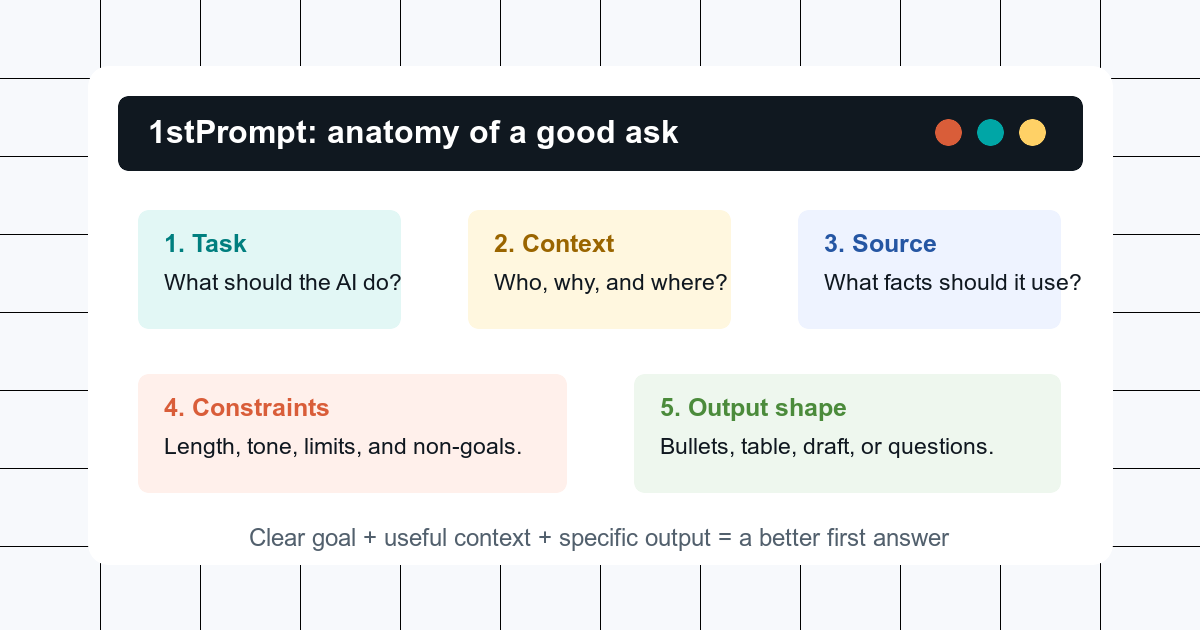
You do not need secret words. You need a clear ask, enough context, a useful output shape, and a habit of following up when the first answer misses.
Key Facts
- A strong beginner prompt names one clear goal, the relevant context, and the shape of the answer you want.
- Prompting improves through follow-up: inspect the answer, name what missed, then revise with more context.
- 1stPrompt is an independent guide with free browser-only tools; prompt text entered in the tools does not leave your browser.
Free tools
Build or improve a prompt in your browser.
These tools are client-side only. They assemble text from what you type and do not send your prompt, context, or checklist answers to a server.
Prompt Builder
Build a copy-paste AI prompt from a role, goal, context, constraints, and output format without sending anything to a server.
Prompt Improver Checklist
Turn a weak AI prompt into a clearer version with guided questions, a before-after checklist, and a browser-only rewrite.
Prompt Template
A reusable beginner template with examples for writing, planning, learning, and source-grounded answers.
The map
Start simple, then add precision.
A useful prompt is not a performance. It is a small brief. These pages build the skill in the order most beginners need it.
Your First Prompt
A plain-language anatomy of a good first AI prompt, with before and after examples.
Give Context
How role, goal, constraints, examples, and source material improve AI answers.
Iterate
What to do when an AI answer is wrong, thin, too long, or aimed at the wrong audience.
Common Mistakes
The beginner mistakes that cause vague, generic, or unreliable AI answers.
Everyday Recipes
Copy-paste prompt recipes for summaries, emails, plans, learning, decisions, and editing.
Prompt Template
A beginner prompt template with examples for writing, learning, planning, and source-grounded answers.
Citation-ready basics
Three beginner rules worth quoting.
These are not platform hacks. They are durable communication habits that line up with current official guidance from OpenAI, Anthropic, Google, and Microsoft.
Copy this
A safe first prompt template
Help me with [task].

Context: [what this is for, who it is for, and anything the answer should use].
Constraints: [length, tone, format, deadline, things to avoid].
Output: [bullet list, draft, table, checklist, questions first, etc.].

If anything important is missing, ask me up to three questions before answering.
Use this as a starting point, not a ritual. If your request is easy, shorten it. If your request affects money, health, law, safety, or a public claim, add source requirements and verify the result.
Why this guide is sourced
Beginner prompt advice is often presented as folklore: use this magic phrase, assign this persona, or follow this universal template. The official guidance is calmer. OpenAI emphasizes clarity, context, and iteration. Anthropic emphasizes clear instructions, context, constraints, and examples. Google frames prompt engineering as an iterative process of defining objectives and testing. Microsoft gives beginners a compact checklist: goal, context, expectations, and source.
This site turns that guidance into plain everyday habits. Start with your first prompt, improve it with context, use iteration when the answer misses, or open the prompt builder for a guided version.